
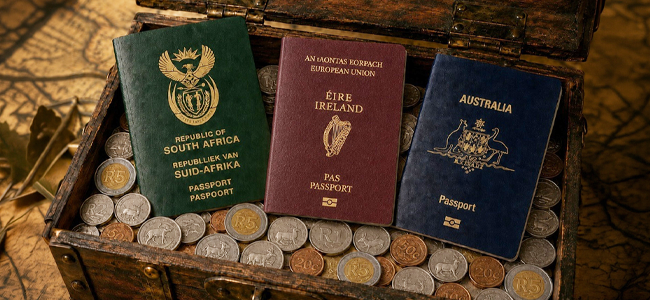
“There are only two lasting bequests we can hope to give our children. One of these is roots, the other, wings.” (Johann Wolfgang von Goethe)
When affluent families gather to discuss their long-term plans, the script is normally pretty predictable. They talk about things like investment portfolios, trust structures, succession plans, and tax legislation. But one question is seldom asked.
Is our family’s citizenship strategy fit for the future?
For many years, citizenship was little more than an administrative fact. It determined where you voted and which passport you carried through an airport. All that’s changed. Increasingly, globally connected families are recognising that citizenship is more than a legal status. It’s a strategic asset capable of expanding opportunities, protecting future generations and strengthening a family’s resilience.
These days, companies operate across continents, children study at universities around the world, and family members often build careers in countries their grandparents can’t even pronounce. At the same time, geopolitical tension, changing tax regimes, economic volatility and evolving immigration policies have shown that stability can no longer be taken for granted.
Against that backdrop, we are beginning to redefine wealth itself
For decades, financial planning has focused on preserving capital. Diversification meant spreading investments across different asset classes, sectors and geographical regions to reduce risk. It was built on a simple principle: never allow too much of your family’s future to depend on a single outcome.
In recent years many families have diversified their investment portfolios internationally. But relatively few have asked whether the same principle should apply to something as valuable as the legal rights and opportunities available to future generations.
Unlike shares, property or private businesses, citizenship cannot be measured by annual returns or quarterly performance. It produces no dividend, pays no interest and appears nowhere on a balance sheet. Its value lies elsewhere.
Citizenship creates optionality
Citizenship is the key to a future where citizens can study, build careers, start businesses or retire visa-free. It can also affect access to health care, legal protection and political stability. It’s like insurance: you don’t know its value until things suddenly change.
The COVID-19 pandemic was a sobering reminder of how fragile international mobility is. Borders slammed shut virtually overnight, travel rules kept shifting, and continents separated families.
For families trying to preserve wealth across generations, the planning conversation is no longer confined to where capital should be invested. It should also include where future generations may wish—or need—to build their lives.
This is not to say that every family needs multiple citizenships, or that citizenship should ever be a status symbol. Instead, it deserves the same disciplined thought we give every other major family decision: What risks do we need to take on today, and what opportunities do we want to hold for tomorrow?
A governance conversation
Questions that once seemed unusual are becoming increasingly relevant.
- Will future generations have the flexibility to establish themselves where opportunity exists?
- Have cross-border succession issues been considered?
- Are family structures capable of supporting an increasingly international family, or are they still designed around outdated assumptions?
Without shared values, thoughtful governance and careful preparation, additional citizenship merely gives people more places to make poor decisions. The most enduring families understand that true legacy is never created by documents alone. It is created by preparing people to use the opportunities they inherit wisely.
Perhaps that is how we should begin to think about citizenship. Not as an immigration decision, a tax technique or simply another passport, but as a strategic investment in a family’s future.
Disclaimer: The information provided herein should not be used or relied on as professional advice. No liability can be accepted for any errors or omissions nor for any loss or damage arising from reliance upon any information herein. Always contact us for specific and detailed advice.
© FinDotNews